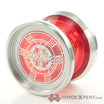
When I first got this yoyo, the middle of the “Duncan” engraving and the middle of the “Haymaker OG” engraving aligned. After a couple years of unscrewing and screwing it, to undo kinks and maintain the bearing, I’ve noticed the logos slightly drifting out of alignment. I’ve never dinged it or impacted it hand, just some bumps against carpeted/hardwood floors. And it plays fine, it’s as smooth as would be expected from a bi-metal, it’s not like it’s unscrewing during play. It’s just the tightness sweet-spot seems to be increasing.
I had a Replay Pro a long time ago which had this pattern. YYF plastics have little alignment arrows, and over time I had to tighten it further past alignment to stay secure.
Am I overtightening my Haymaker? Or is it natural for alignment to increase over time?
I’m about to buy my first OneDrop, if you share any threads/vids about proper tightening, I’d really appreciate it. I also don’t know anything about “tuning” a metal yoyo for smoothness, so I’d love to read about that.
I would consider this as more wear and tear on the axle and threads. It’s normal and has happened to many of my yo-yos over the years too.
When a yo-yo is manufactured, the hub and axle threads may be a bit rough. During initial assembly, the threads and axle are joined and tightened for the first time and while tight, they might not be perfectly seated due to imperfections and machining grit. So while it will pass QC and play well, each time you open and tighten the yo-yo, it will slowly wear away on the threads. Eventually this will affect the fully torqued position to the point that alignment marks or etchings no longer line up.
Mine don’t line up either. It still gets plenty tight and doesn’t loosen during play so no problem. If yours is the same I would also say… no problem.
fradiger
(the world is a beautiful cat and i must meow meow meow)
4
my advice for screwing your yoyos together to avoid stripping:
use good bearings, cheaper ones tend to have tolerances that are a bit looser and so you can sometimes end up with a VERY tight bearing that starts to chew up the post. you’ll also find that with cheaper/lower quality manufacturers they will oversize the bearing post by the smallest amount since it decreases b grade rate (this is also something that commonly happens by accident with anodizing, since that is going to add thin layer on top of everything)
worth noting that NSKs are one of the commonly-named premium bearings, but they have tight tolerances and tend to fit slightly tighter than most yoyo bearings, so if you have a yoyo with a bearing post that is already death gripping normal bearings an NSK might end up shaving down some part of the bearing post (though I am a huge fan of NSK bearings otherwise and use them in all the yoyos i really care about where possible, IMO a yoyo is incomplete without your favorite pads and a good bearing)
when you’re removing bearings try to avoid using too much back and forth wiggle, since if you aren’t careful (especially with posts without a chamfered edge like on older yoyos) you can shear off material over time. if you’re willing to make an investment, bearing removers like the azumi techno one can remove bearings without as much wiggling:
when screwing a yoyo back together, I like to get the axle finger tight in one half and then slowly rotate the other half of the yoyo backwards (like you would unscrew it) with very light pressure, you’ll eventually feel the threads ‘click’ (practice this with a yoyo you don’t care about) into place, at which point you should be able to screw the halves together
don’t palm grip both halves of the yoyo when reassembling, use your fingertips on the rims on each half to avoid cranking down the yoyo super hard, i know some yoyos with tight seats do require a bit of cranking down, but do your best to not go crazy
remember to clean the bearing posts/seats of your yoyos every once in a while (i just do this when i’m changing pads) since you can accumulate gunk there, and also inside the threads of the axle hole (i’ll take a qtip, usually peel some of the cotton off, dunk it in isopropyl alcohol and get in there, just be sure that if you’re using something with water content to dry things afterwards