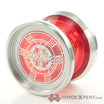
The story for ANTiFRAGILE on the Yoyofriends website shows un-machined material. This doesn’t necessarily mean that these were a step before machining.
I also have this super vibey crystallized Ti Enso from Nats 25 that has super pulse earthquake vibe while still being extremely playable. It looks awesome but I think this design is simply resonant. Also the axle length is crazy short which might be part of the vibe.
Some of the guys at the Enso booth also said that apparently if you have certain angles where it contacts the string it tends to cut strings. Something about the structure of the metal.
I have one of the Antifragile yoyos in the Blue fade colorway.
I have enough yoyos to choke a Transformer….. And this Titanium yoyo is easily one of the very smoothest yoyos I have or for that matter, all yoyos I have ever had the pleasure to roll down a string.
I can fully understand why the Company says it is their current Flagship yoyo..
There are no doubt a few other Titanium yoyos that are quite amazing but they are primarily Ti yoyos with Stainless rims.
The Antifragile just squeezes the most out of mono Ti and I am not sure how they did it?
But certainly Happy they were adventurous enough to do it, lol.
And here a question arises: is the treatment only superficial? Judging by those bars, you wouldn’t think so, but then how can that masking be achieved? If the treatment involves the entire mass, even sanding cannot obtain an untreated surface. If it only concerns the surface and therefore is done on machined pieces, what can be used to mask that part that resists 1200°C?!?!?
And a small clarification, perhaps a matter of precision, on terminology. The term “crystallized” or “crystallization” for this type of industrial process is completely inappropriate. An element or alloy that crystallizes does so by completely changing its physical structure and becoming transparent like crystal… two of the best-known examples are carbon (graphite powder, for example), which when subjected to high pressures and temperatures becomes diamond, or aluminum powder, which with the same process becomes corundum, commonly called sapphire (the glass of many watches these days).
Those are crystallization processes, not this one.
Apparently it is kind of superficial. The treatment is throughout the metal, but only visible as the crystallized pattern on the surface after acid etching the finished piece.
From the photos of the bars posted and from the photo of YYFr posted by you of the two pieces of bar that need to be CNC machined, it seems that the treatment involves the entire mass of the metal…
I believe the crystalline structure is finally revealed after etching with hydrofluoric acid after the STA heat-treating. Like with any acid, the surface is differentially etched away, which can cause very small ‘ridges’ that could lead to increased string wear, so they mask the bearing seat area prior to etching.
The “crystallization” process is done in an electric saucepan!!! I think it’s not necessary to reach such high temperatures as was mentioned at the beginning…
This is due to aluminum segregation in the grain boundaries in the alpha phases. HF is very aggressive on Al so that’s why you get such striking grains.
I gather that the last step is just to reveal the structure that the intense temperature treatment creates(?) Otherwise, the patten is there but doesn’t “pop” to the same extent.
You’d be correct. The heat-treating and aging processes create the large crystal grains. The etch (HF or HCl) reveals those grains through selective corrosion.
I have access to HCl and I have a Ti yoyo sitting on my desk. I might try to etch it and see what happens lol.