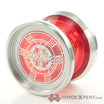
Below is the yoyofriends ANTiFRAGILE, a grade 5 titanium yoyo that was heat-treated above its beta transus temperature. Grade 5 titanium (from what I can tell from some preliminary research) exists as a dual-phase microstructure below 1050C. If you can heat above this, it transforms into a solely beta phase, accompanied with increased grain growth and slightly increased hardness/brittleness.
Now as someone who works with heat-treating quite closely, albeit on the steel side, this fascinated me immensely. It also got me thinking: “hey, I have access to a furnace that can reach 1050C”. We typically run coated steels that don’t require an atmosphere, and if we do, use we nitrogen. Now heat-treating titanium requires either a vacuum or an argon atmosphere; using nitrogen will leave you with a nitrided surface that is much harder, but it’s solid black and you don’t get the same large grain effect (or at least you can’t see it).
I’m very intrigued to try this myself. I should probably start with some cheaper titanium sheets to test out the process before I risk ruining a yoyo. But does anyone here have any experience with something like this? Two big questions I have are: is 1050C hot enough? That’s really the limit of our furnace and I really can’t be breaking it. Also, what’s the typical heating time? 2 minutes? 5 minutes? 2 hours? This is a really cool ‘finish’ and I’d like to replicate it.
I’m struggling to find a good CCT curve. This one looks good, but with an M_s temp of like 1120C, that differs from what I’m finding in literature that the M_s temp is closer to 870C. EDIT I’m very dumb. The temp scale is in Kelvin. 870C =~ 1140K.
From my understanding, you want to stay left of the dotted line so to not transform your pure beta phase in alpha + beta. Instead you want all your beta phase to transform into alpha prime. But again, this differs from the literature that says that you end up with a beta phase and you then age your titanium to promote small nano-alpha formation within the beta phase.
Reading more, the a’ transforms into fine a + B, which has lower toughness compared to coarse a + B (which most grade 5 Ti yoyos exist as), partly due to larger grains.
Ok so from YYE’s description: “What sets this yoyo apart is its crystalized grade 5 titanium (Ti-6Al-4V) construction, heat treated up to 1200 degrees Celsius for a subtle hardness boost and a stunning crystalline pattern that gives every piece a one of a kind “ice-crack” look under the light.”
This makes me believe they end up with a primarily a’ martensitic microstructure and they they likely were not air-quenched, but probably water/oil-quenched. Quenching in air, I believe, would leave you with properties closer to ‘standard’ grade 5 and you wouldn’t get the hardness bump. Though I believe either should still give the large grain ‘ice-crack’ appearance.
I can’t help you, and I believe you have a lot of expertise in this field, but if I understand correctly, the main result of this tempering process is aesthetic rather than physical improvement, such as increased hardness, greater resistance to deformation due to impacts, etc.
Of course, tastes are personal; I don’t like the aesthetic effect at all, at least the one in the photo… It looks like a kind of low-quality cold galvanizing, and if there aren’t significant improvements in physical characteristics, I wouldn’t even try, as it’s possible that the increased heat, in an alloy that, while never homogeneous, could lead to vibration problems (as The Shield teaches). Aesthetically speaking, your Acadia is much nicer. Anyway, if you decide to try, good luck!
That’s what actually makes me so drawn to it! I’ve always liked the look of a galvanized part, but I’ve always hated how zinc ‘feels’. This, to me, seems like the perfect solution.
Properties shouldn’t be massively different. If anything, the tensile strength, yield strength, and hardness should go up and the elongation/toughness should go down (which is a bit counterintuitive to me since usually larger grains = higher toughness).
So I believe you’d be facing a slightly higher risk of shattering your titanium yoyo. The likelihood of that happening should be close to 0%.
So I dug into this and it’s basically the same process: heat metal up, hold at temp, quench. Most crystalline metals experience grain growth at elevated temps, which is what you’re seeing here. Within each ‘grain’, the crystal structure is perfect. The edges are where the atoms don’t align perfectly.
Maybe a silly question but do you think the Ti is treated before machining? I’m just thinking that if your physically changing the structure to get this effect, it might induce some vibe if done post machining.
Not a silly question at all! Quite the opposite, really. A solution heat-treat and aging (STA) of Grade 5 Ti can increase the hardness from 5-10 HRC, which is very significant. Titanium is already a bit of a hassle to machine, and making it harder only makes it…harder…to machine.
So I’d speculate the STA was done after machining. You’re right that it could easily introduce vibe, so if anyone has one that wants to comment on its smoothness, that’s be great.
I wouldn’t say it’s all that different. Sure, it has color, but that’s simply due to applying a voltage to the metal. The website says a crystallized titanium, so I’d suspect a similar heat-treating process, but probably a lower time in the furnace given the finer grains compared to the yoyo.
and honestly I’m not very enthusiastic about this either… now if “those grains” can be useful to obtain combined multicolored effects like on the handle of that knife then I see an aesthetic utility in it, if they have to give the impression of “scales” of slightly different shades, honestly I don’t like them… but we’re talking about personal taste, nothing more…