












After a few days of use I would like to answer in more detail the question of @yoyojoe and the interest of @fourcorner and @twitch77 .
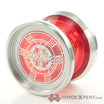
Sumo is a high quality yoyo marketed in 2007 by the Italian company Brokenyoyos.
According to its creators (Niubi, Saxa and Speed12), it was a yoyo specifically designed for the 1A style of play and for thumbgrinds.
It was produced in Modena by highly specialized professionals, suffice it to say that within 20 km of this city are the best and most famous Italian sports car manufacturers… Ferrari in Maranello, Lamborghini in Sant’Agata Bolognese, Pagani in San Cesario sul Panaro, Bugatti (in the Italian period) in Campogalliano, etc.
So you understand the high specialization of these professionals, which is also found in the obsessive precision that distinguishes this object, just look at the difference in weight between the two shells of my WYYC 2007 … just 2 hundredths of a gram! (which could probably be due to the silicone)

When this prototype arrived at my house, I was surprised to notice a big difference in weight between its two shells, 1.4 grams! I said to myself, but how is it possible?!?!?

Considering that it is a unique piece, both for technical specifications and for graphic engravings and therefore there may not have been an exchange of shells with another similar prototype, this impressed me a lot and made me observe its characteristics more carefully than with the as time went by they started to “tell” important things about the development of this project.
Let’s start by saying that this yoyo did not have a simple birth.
Over a year and a half has passed from its initial idea to its commercialization, this is because in the face of an excellent workmanship, the finish, intended as anodic coloring, has given many problems, not so much in aesthetic but in mechanical terms because the processes often involved the loss of tolerances considered in the turning phase, with problems of seizing the bearings in their seats.
4 or 5 companies were involved that carried out anodizing of various types and with various colors, this also meant that very few specimens of undeclared colors were produced, needless to say, very coveted by collectors (examples are the blue Sumo with graphics - 2 pieces, the green Sumo with graphics - 3 pieces, the light blue Sumo without graphics or black with or without graphics, very few pieces, etc.)
In this prototype, arrived from an Italian collector and friend (thank you very much Mojo !!! you gave me an immense gift!), Very different from what the final yoyo would have been, evidently these issues were in full swing and was being sought trying to do of the tests to solve them, this must be the reason why, both the housing of the axle and the seat of the bearing are of different sizes, clearly visible, especially noting the different thicknesses of the edge that delimits the bearing seat from the grooves of the system of response.
Also the bearing seat is also different, on one half it has a 45 degree bevel and on the other it has a sharp edge.

The best solution and measure to the anodizing process was probably being tested.
As for anodizing, this prototype was used as a coloring test for what would have been the first Sumo sold as standard, the WYYC 2007 (exclusively sold by the Infinite Illusion store) however the anodizing of these two cups are much brighter than those that would then be made on the standard models (WYYC and gold edition).
Even the laser engravings, in addition to the fact that they integrate the writings that are placed on the rims in the standard models, are deeper, probably due to multiple laser passages, this makes them, in the presence of more than 13 years still totally white while on the models of series in my possession, dark spots of oxidation have surfaced from the aluminum below (7075 alloy), mainly on the writing.
I can’t explain why these processes, tested on these two shells, have not been redone in the same way on the series models.


(Gold - Proto light - WYYC 2007)
Let’s now turn to the considerations on how this prototype plays compared to the series models.
This yoyo weighs 60.3 grams (7.2 less than the standard models).

This weight is more than enough to obtain a yoyo of excellent playability, in this specimen, however, the weight has been mainly removed from the rims (as well as from the hubs and from the whole inside of the cup, in minimal part), this entails a minor backlash to the I throw compared of the standard Sumo but also a minor spinning, in fact this yoyo has a remarkable rotation force which gives it a remarkable and pleasant playing capacity but when this strength decreases the yoyo starts to do a little what it wants, bending or turning in direction changes, which a standard Sumo doesn’t do.
This prototype, despite having been lightened a lot in the edge, still retains a remarkable lip (predisposition for thumbgrinds), much more refined but always efficient.
A lip so tapered was made reaching the limit of the possibility of inserting the tool, this led to a slight little machining problem in a shells.

Ultimately a good yoyo but certainly not as good and performing as his standard brother, fully playable but that requires a very high attention and precision from the player.
However, a unique object that has a lot to tell to those who have the pleasure of listening to how much, behind an apparently banal object like a yoyo, there can be a whole world of tests, attempts, difficulties and satisfactions.
In short, life !!!

 )
)


