









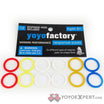







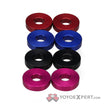


I also cut them 1.2 mm. I only use Yoyofactory pads, other brand might differ.
Do any of you know what the ID of yoyo factory pads are?
I cut the grooves at 15 mm inner diameter and 19.25 mm outer diameter if that helps
Does anyone else have specs that they like to use for the ID of yoyo factory pads? Also, I’m sure somebody else posted about this a sometime, could anybody point me towards that thread?
Could someone explain axle depth to me? I know that it depends in the length of the axle, let’s take a ten mm axle for example. Dose the hole need to be longer than half of the axle so the that it doesn’t brake the yoyo? Or does it need to be the exact length so you don’t get more of the axle on one side?
1 Like
The hole needs to be a bit longer as tap doesn’t thread the hole all to way to the bottom, the front of the tap is tapered. It also depends on how long you make the bearing posts of course.
1 Like
Keep in mind a tapped hole “half the axle length” doesn’t account for gap.
When I’m modeling in fusion I mirror my halves, set them at the right gap and measure from inside of post to inside of post then reduce down to the nearest standard m4 grub screw. For example if it comes out at 11 mm end of hole to end of hole I’m gonna size down to a 10 mm axle.
As far as required depth actually goes. A good rule of thumb for all machining is that your depth should be at a minimum the diameter of your screw in order to set properly without unscrewing during use. So with m4 axles you will want at a minimum 4 mm of depth on each side or you risk unscrewing.
1 Like
When tapping holes for industrial pieces the standard rule is having thread 2.5 times the diameter of the tap (for an m4 tap this would be 10 mm).
Luckily this doesn’t apply to yoyo’s as the only function of the thread is holding the yoyo together, thus less mechanical forces are involved and we can get away with much less.
I’ve used 8 mm long axles before with no issues but I prefer 10 mm ones as having more thread helps prevent stripping by overtightening.
1 Like
Interesting! My main machine shop normally does Aerospace and not yo-yos but they analyzed some of my designs and told me to stick to a depth >= diameter rule so I’ve tried to live by it.
1 Like
I’ve talked to my machine shop and they said the can tap a hole without the taper that comes from the drill bit would that be better? Also if I have a 2mm bearing post that leaves a .375 mm gap between the center of the bearing. Should I make my post longer? What I mainly meant is that on the axle depth if I had a 10mm axle and I have exactly 5mm of threading and gap so that it will bottom out or do I need extra room so that the end of the axle doesn’t bottom out. Sorry I thought that I was on the Cad and prototyping adventures thread.
Import an m4 10mm threaded rod and overlay it on your part. It’ll show you where entering lines up after assembly. For this to work, your sketch needs to be aligned so that the bearing seat is 1/2 the width of the bearing away from the 0 point on the x axis.
2 mm is more than long enough for the bearing post, even 1 mm is enough tbh. Don’t worry too much about Axle depth, at the end of the day it only needs to hold the halves together. There’s some room when it comes to that, diameter tolerances are more important. What you have now sound good but you could always drill a tad deeper if you’re unsure.
If you haven’t got some already get yourself some digital calipers and just measure what other manufacturers do. It’ll give you an indication of what works when it comes to the small technical stuff (bearing seats, posts, response grooves). Measurement won’t be good enough for bearing tolerances but should be more than enough for anything else. I use mitutoyo calipers but those aren’t the cheapest. Someone here might be able to recommend a cheaper but good alternative.
The whole bearing seat/axle thing is important but the more fun part is all the rest of the yoyo.
Have fun!
Does the flat axle hole sound like a good idea?
1 Like
I don’t imagine it’s needed. Unless you have a very thin wall between the inside and outside of the post and are worried about the tap deforming the post and poking a little nipple out of it.
1 Like
I’ve been looking at these pads and supposedly they are 1.15 mm deep. Do you still recommend 1.2 mm deep?