













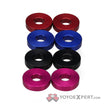


Yes, last time I made pads I ended up with 10,000  if that happens again I’ll let @Lotaxi have pads for my cost if he wants them.
2 Likes


5 Likes
Thank you!
1 Like
Any time! Also, just a heads up I noticed some variation of thickness in the pads I got my hands on. Some are CONSIDERABLY thicker than others…
2 Likes
My shop is custom making the silicone pads to in theory precisely fit the recess and eliminate that tolerance!
3 Likes
Wait so are you printing or are you having them molded/cut? Because if it’s molded/cut with an adhesive back I’d love to discuss
2 Likes
They will be cut or vacuum formed silicone with adhesive backing. I will be having a large quantity made. I don’t have a price back yet, but last time I had custom vacuum formed pads made it cost me like $400 for 10,000 so assuming this ends up being similar, I will have plenty of pads to sell you for cheap.
1 Like


I’m working on a yoyo that has un inserted aluminum hub that holds the guts of the yoyo and was wondering if any one had any experience with using un inserted hub. How wide do you think I need to make the hub to have it seat firmly into the body?
can you send a drawing showing what you mean?
This is a very basic drawing but kinda shows the idea.
I’m wondering if any of you knew how wide should make it so it has enough surface area wile still remaining low center wieght. Also how tight should the tolerance be?
1 Like
Is this going to be press fit into a yoyo?
This won’t work, the yoyo body will slide off
Okay, it was just an idea. I noted that in your video you set the bearing post to the exact size of the bearing don’t you want a little give? Also in your bi-metal video you did not recommend a tolerance either. What should that be?
Mark probably didn’t include tolerance (and possibly set the post to a precise bearing diameter not sure 100% on this one) because he uses a dedicated yoyo machine shop.
Places like FPM, MYY, Yo-Yo Empire etc don’t require you to set tolerances or even carefully specify bearing seat post diameter and such. You can provide them with close enough and they will determine tolerances and make minor diameter adjustments themselves before machining.
I can add in my two cents since I don’t use traditional YoYo shops and am machining from the Wild West of shops that normally serve aerospace, medical, etc. I bring in my post -0.03 mm from the diameter of the post and set a tolerance of +/- 0.02 mm. I have heard that a tolerance of 0.01 mm is preferable, however my main shop has told me that 0.01 is prohibitively expensive so I’ve been rolling with 0.02. These settings produce a yoyo with very very minor vibe but allow you to remove the bearing without a tool. It produces a bearing seat that is IMO comparable to One Drop.
IMO most YoYo machine shops are likely making the post exactly bearing hole size or even a little larger than the actual bearing hole size in an effort to stamp out as much vibe as humanly possible and then press fitting the bearing onto the post.
5 Likes
I 3D printed that size of post and the bearing wiggled around causing the yoyo to vibe and spin out in a couple of seconds. I’m not sure what went wrong, do you have any suggestions? Also for bi-metal yo-yos what do you size the ring ID compared to the body OD?
1 Like
I would need a lot more info to go off of in order to make any guesses what went wrong.
I can give you general guidance on how I diagnose these things in my prints though.
- Check the actual printed dimensions with a nice pair of calipers vs the design. Make sure they are close. 3d printers can require some tuning or at least print profile tuning to get accurate dimensions.
- Check your seems. Do you have a big thick seam adding extra weight to one side?
- Check your overall weight and your weight distribution. You can also try pulling some weight in from the rims to the center and see if it reduces vibe. Wide rim heavy 3d prints are more prone to vibe because wide rim heavy yo-yos require more precision and tighter overall tolerances.
- Check your bearing seat in all dimensions not just the post. Make sure the actual seat the bearing rests on is nice and fat, if it s a c bearing you have lots of room to add a big fat lip for extra stability.
- Check your hardware, make sure everything is tight without being so tight it damages the print.
- Check your filament. Is it fresh and dry? Is it high quality or does it deform with minimal pressure?
- also if this is going to be machined eventually (I’m assuming so based on the tolerance questions) remember that this 3d print will honestly not work as an analog for testing how well a machined yoyo will work. You really have to design 3d printable yo-yos for the purpose of 3d printing keeping the limitations in mind.
2 Likes
Part of it is shrink rate of the plastic and the other part is the plastic is laid out in lines based off of the nozzle thickness so sometimes it’s a give and take to get the bearing post thick enough and once you do the pads are another issue. I also recommend random seems so you don’t have the thick aligned seems.
2 Likes
So you would still recommend this diameter?
I think we would need significantly more information to give more advice.
1 Like