














Thank you so much!
Which one is better for beginners and why? (POM or PC)
1 Like
I would suggest PC due to its light weight (10g), as a lighter CW usually helps you learn 5A basics more easily. This is because it spins pretty fast, which means you won’t have to use as much strength to swing the CW while moving the yoyo at the same time.
2 Likes
Excuse me, but if the focus of this project is the ability to customize the weight of the dice, and given that there’s a space inside it that can serve as a housing, why not provide it with washers of various materials (metal, plastic, rubber, such as O-rings) with a defined nominal weight so that by adding, removing, and varying these washers, each player can truly find the weight that’s best for them, rather than being restricted to three or four predefined settings?
I don’t know, I’m just putting it here as an idea for later development/implementation.
P.S. This was also done on yo-yos, such as the B!ST Competizione, which has threaded hubs both on the outside and inside because it came with two sets of nuts, washers, and other accessories, both plastic and metal, for complete customization of the yo-yo’s weight. Unfortunately I only have a plastic set…


1 Like
Hey, hope your day is going well! Thank you very much for your recommendation!
I really love your idea, however there is one weakness when placing an O-ring inside, it tends to pop out when the player assembles and disassembles it repeatedly. Placing the rubber ring on the outside could also be a reasonable option, but wrapping a rubber ring around the outside of the CW will increase its weight, and in return, the flight trajectory during play will feel much more uncomfortable compared to placing the O-ring or rubber ring on the inside.
However, I have already prepared a solution to provide more options for reinforcing the CW’s weight without destabilizing the flight trajectory or having the O-ring pop out when opening the CW. This will be launched in the near future.
As for being limited to only 3 or 4 fixed setups, that is not entirely accurate. Players are free to remove the bearing or swap it for a bigger one to expand their options further. And moving forward, it will no longer be limited to just POM or PC materials, it will be expanding into much more.
Anyway, thank you so much for reading and i hope this answers help you. If you have any other questions or suggestions, please let me know. I would love to hear. Wish you an wonderful day!
2 Likes
clearly it wouldn’t just be a matter of inserting o-rings into the system you created, it would be a matter of redesigning its interior to obtain a specific space that can contain and hold them (a pin on which to place them). As for external o-rings, I would exclude the idea because in addition to dirtying the clean design of the dice (it is made with extreme precision to give a sense of having continuity between the two halves and then you go and put a rubber ring?!?!) I believe that even during play it causes problems, both in terms of uneven grip and rebound in the event of a collision with the yoyo, parts of the body, other surfaces.
As for this point:
the thing is unclear to me and given that in the image you published a few posts above you state that more than 20 possible weight configurations are possible by also changing the size of the bearing or removing it completely but honestly I can’t understand how it is possible because the bearing has a very precise seat in the middle of the dice, designed for that specific diameter of its external race and the tool that holds the string has a very precise diameter that it fits perfectly to that of the inner race of the bearing, so how can you use a larger bearing or of different sizes?!?!? or how the nut can continue to function without a bearing in it?
I believe that at least a video is necessary that explains and shows how it is possible to make these modifications and obtain all these different weight configurations.
1 Like
Hey, thanks so much for coming back with this. Questions like these help me explain the design better, so I appreciate you taking the time.
On the o-rings, that’s not something we’re pursuing, internal or external. It would mean restructuring the interior for a seat that isn’t there now, and externally it breaks the clean two-half look we’re going for. That one’s closed on our end.
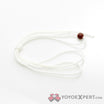
On the bearing setups, a wording slip on my part. It’s not “bigger” bearings, it’s still standard size C throughout. The seat accepts both a regular size C and a size C thin, since they share the same outer race diameter. When the bearing is removed, an internal bead takes its place as the string’s contact point, so there’s always a defined seat either way. My mistake for phrasing it as “sizes” earlier.
And yeah, this is the kind of thing that’s much clearer on video than in text. I’ll get one together showing the C vs C-thin swap and the bead-only setup side by side.
Thanks again for pushing on this, happy to keep answering if anything else comes up. Wish you a great day!
2 Likes

7 Likes
2 Likes


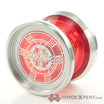
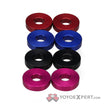
Btw, these are the remaining 3 I found in stock. Still can get at Stand Apart – Quocrea  See y’all really soon in the next one!

4 Likes